Ancient Romans, Schools Loans Box - Loan Box Subscription Service
Ancient Romans, Schools Loans Box |
|
|
Welcome to this loan box from Warwickshire Heritage Learning, part of Heritage and Culture Warwickshire. In this box you will find a collection of original objects to use with your class to help them learn about Roman life in Warwickshire and Britain, provoke conversation and support leaning in the classroom. This pack contains information about the objects in the box and suggested activities that will use the objects. Each activity stands alone and can be used independently of the others. You will also find links to short videos with Warwickshire Museum’s curators talking about the objects in the loans box. Also included are suggestions of how the topic of the Romans fits with the history national curriculum and the substantive and disciplinary concepts it can cover. Object listThis list, from the teacher pack, shows the objects that are included in the Ancient Romans Loans Box. |
|
|
Fibulae Brooch, Bronze A Fibulae Brooch was used to fasten tunics and cloaks. They came in different styles; some were more elaborate than others and would have been worn as a sign of wealth as well as practicality. It was found at Grimstock Hill, near Coleshill in North Warwickshire. 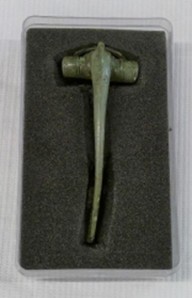
|
|
|
Roman Coins, Late 3rd or Early 4th Century – 350–400 CE These Roman Coins would have been the main currency of Roman Civilisation. The Romans used money to buy goods; they did not use a barter system. Traditionally, coins had the image of the Emperor on the ‘obverse’ side. Usually, the depiction of the Emperor told a story: Emperor Vespasian used an image of Mars, the God of War. It is mythologised that Mars bore the two founders of Rome – Romulus and Remus – so by using his image, it tells people he is a strong Emperor with a powerful army. These coins were found across Warwickshire by different metal detectorists. 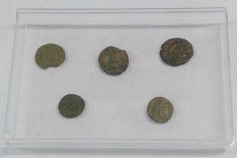
|
|
|
Bone Hair Pin, Animal Bone Bone Hair Pins were used to hold hair in place. It would have been used predominantly by wealthy Romans. Pins would have come in different styles and some would have been carved very elaborately. This object was found in Alcester in South Warwickshire. 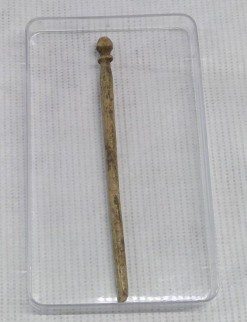
|
|
|
Samian Ware Bowl, Red Clay The Samian Ware Bowl was used as premium tableware for guests and dinner parties. Only wealthy Romans could afford Samian Ware. This pottery was crafted in Gaul, Ancient France and has been found all over the Roman Empire by archaeologists. Each piece of Samian Ware has a maker’s mark stamped on the bottom. You can see this mark in the centre of this bowl. The object was found in Alcester in South Warwickshire. 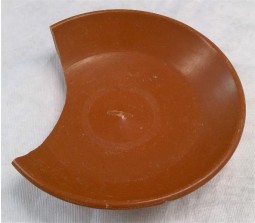
|
|
|
Roof tile, ‘Tegulae’ Tiled rooves were common in Roman towns and countryside villas. This specific tile is called a ‘tegulae’. These tiles were laid side by side on a wooden frame and then secured together by a curved tile, called an ‘imbrex’. The ‘imbrex’ tile would be placed over the join of two tegulae to make the roof waterproof. This object was found in South Warwickshire, but the specific location is not known. 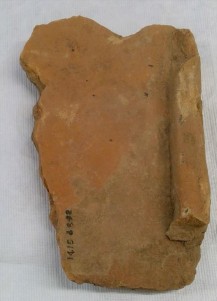
|
|
|
|